
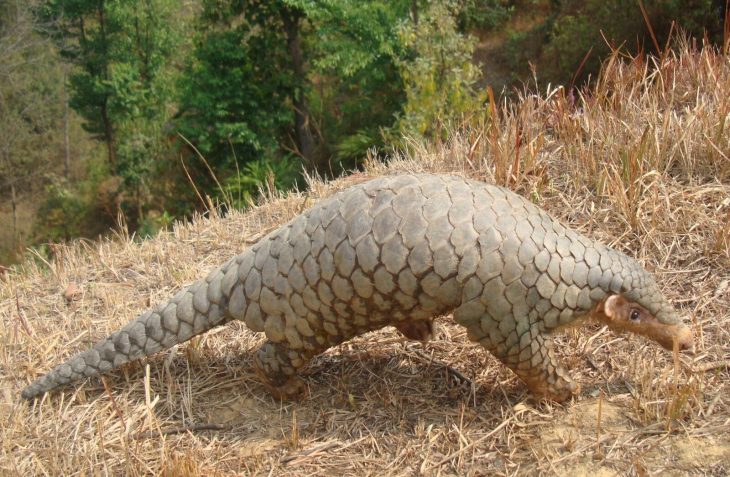
A team led by researcher Narayan Koju of Pokhara University has shown, through genetic analysis, that Nepal’s pangolin is not the same species as the Chinese pangolin found in China and Southeast Asia.
It’s a distinct species now being called the Himalayan pangolin (Manis aurita), found across Nepal, Bhutan, northeastern India, and southern Tibet. The findings were published in Communications Biology, a journal from the Nature group.The key evidence came from an unlikely source: a roughly 200-year-old specimen collected around 1836 by Brian Hodgson, a British diplomat and naturalist who documented much of Nepal’s wildlife during his time here.
That specimen has sat in London’s Natural History Museum ever since. Modern DNA sequencing techniques let researchers pull genetic material from it and compare it against today’s pangolin populations in Nepal — and the match confirmed what the name already suggested: this is its own species.
For decades, the pangolin found across Nepal’s hills has been casually filed under one label: ‘Chinese pangolin. Turns out that name was wrong – and the proof came from a jar in a London museum.
Why the Name Matters
There’s a wrinkle here that’s very ‘science nerd’ but has real consequences: naming rights in taxonomy follow a law of priority-whoever names a species first, correctly, gets their name recognized, even centuries later.
A 2025 study had already flagged this population as distinct and proposed a new name for it, but Hodgson’s 1836 designation, Manis aurita, takes precedence once the DNA confirmed he’d been describing the same animal all along. So the ‘new’ species has an old name.
Genetically, the split between the Himalayan pangolin and the Chinese pangolin goes back about 1.8 million years-long enough for them to have become genuinely separate lineages, not just regional varieties of the same animal.
Why This isn’t Just a Trivia Update
This isn’t only a naming correction for taxonomists to file away. It has real, practical stakes:
- Legal loophole: Nepal’s wildlife protection legislation (dating to 1973) doesn’t specifically name the Himalayan pangolin- it was written under the assumption that the local species was the already-listed Chinese pangolin. That ambiguity is exactly the kind of gap poachers and traffickers can exploit.
- Outdated forensics: Wildlife crime cases often rely on genetic reference databases to identify trafficked animal parts in court. If those databases are still built around the old classification, prosecutions could be resting on shaky species-identification grounds
Where’s the real Chinese pangolin ?
I discuss an open question- could actual Chinese pangolins still exist in Nepal’s districts bordering China, like Taplejung, Sankhuwasabha, Ilam, and Panchthar ? Nobody knows yet, because no one’s specifically sampled for it.
What Comes Next
My take on this discovery is a beginning, not an ending. Nepal needs updated legal schedules that explicitly name the Himalayan pangolin, and a proper nationwide genetic survey to actually map out where each pangolin population lives — especially near the northern border, where the two species’ ranges might overlap.
It’s a neat reminder that a 19th-century museum drawer and a 21st-century DNA sequencer can, together, reshape both science and law.
This post is based on my opinion piece originally published in Nepali by ekantipur.com. An official English version is also available directly from Kantipur for readers who want the original author’s full account.