Category - Science and Environment

Mapping Disaster: A Satellite View of Rasuwa Flood

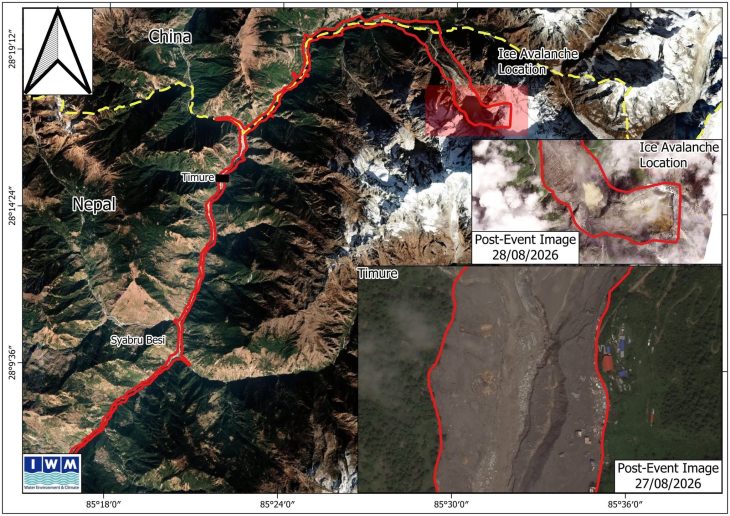
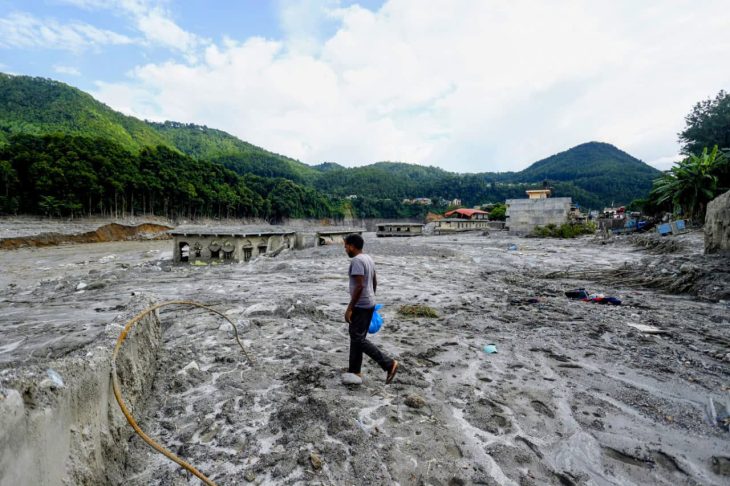
On August 26, 2026, Rasuwa District, Nepal, was struck by a powerful outburst flood, a devastating reminder of the challenges in our mountain regions. This event, triggered by an ice avalanche near Timure, sent a torrent down the Bhote Koshi River. The scale of the impact has been captured and analyzed by international and national Earth Observation programs, and these satellite maps provide critical insights for understanding the event and coordinating response.

The initial view identifies the general path, tracing the red line from the ‘Ice Avalanche Location’ above Timure, down past Syabru Besi. Post-event images from August 27th and 28th show the dramatic changes to the riverbed.

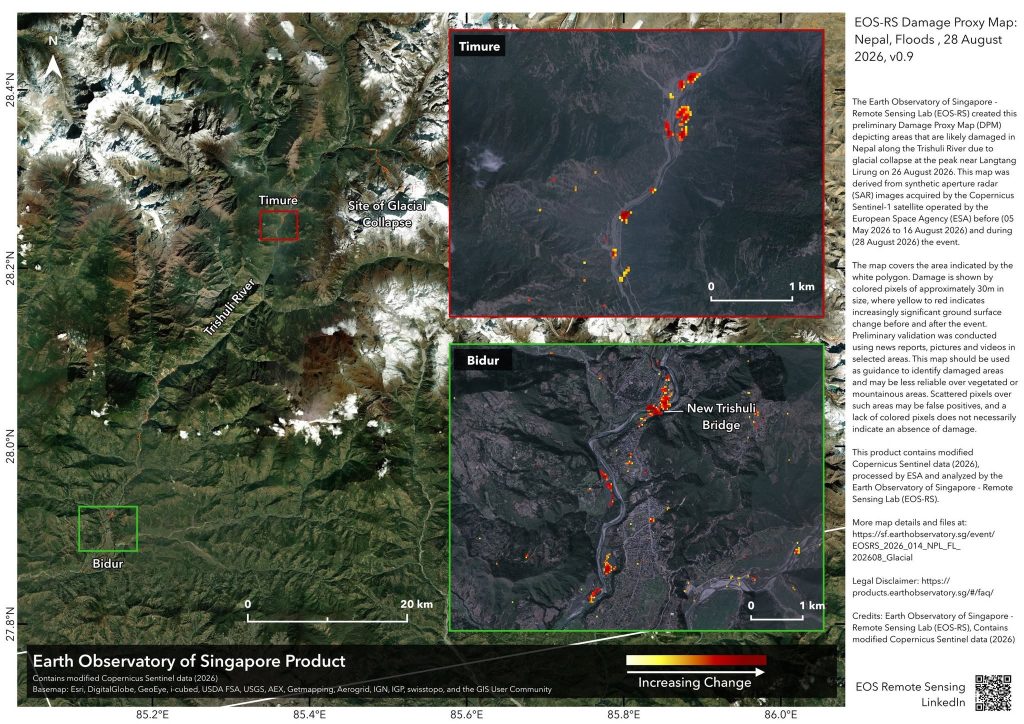
A key analysis from the Earth Observatory of Singapore uses a ‘Damage Proxy Map’.  This map highlights ground surface changes, with a heat map from yellow to red showing increasing damage. It points to critical infrastructure impacts, including damage at the ‘New Trishuli Bridge’ downstream.
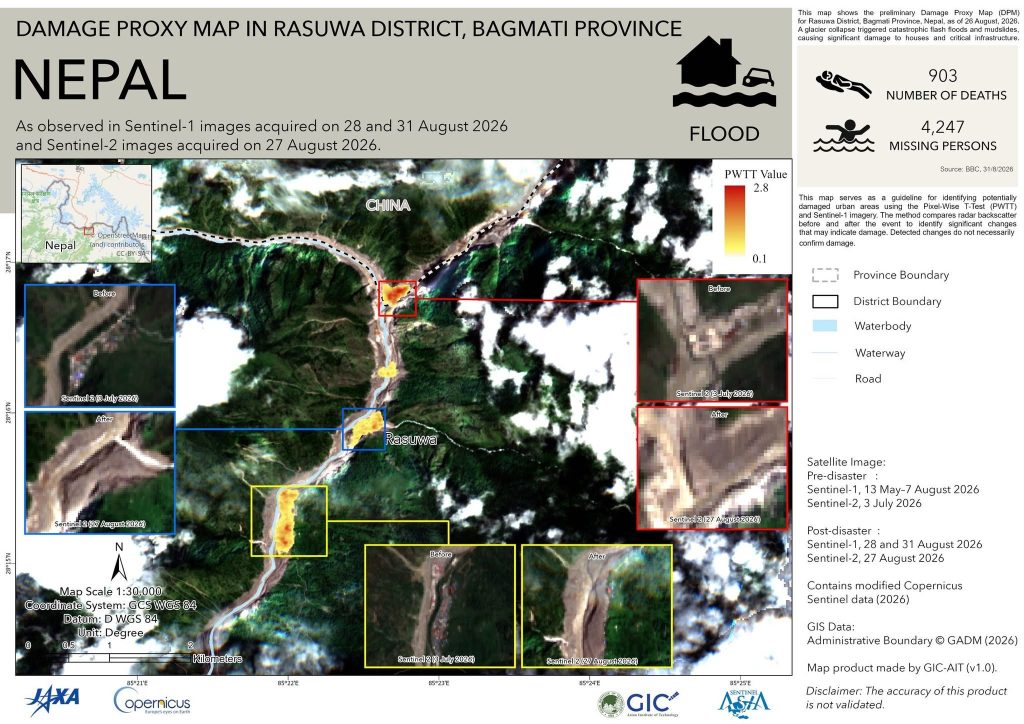
A detailed summary from GIC-AIT is a stark representation of the human and infrastructural toll, citing 903 deaths and over 4,200 missing. Their damage proxy map, alongside before-and-after satellite views, shows extensive damage to the waterway and roads.
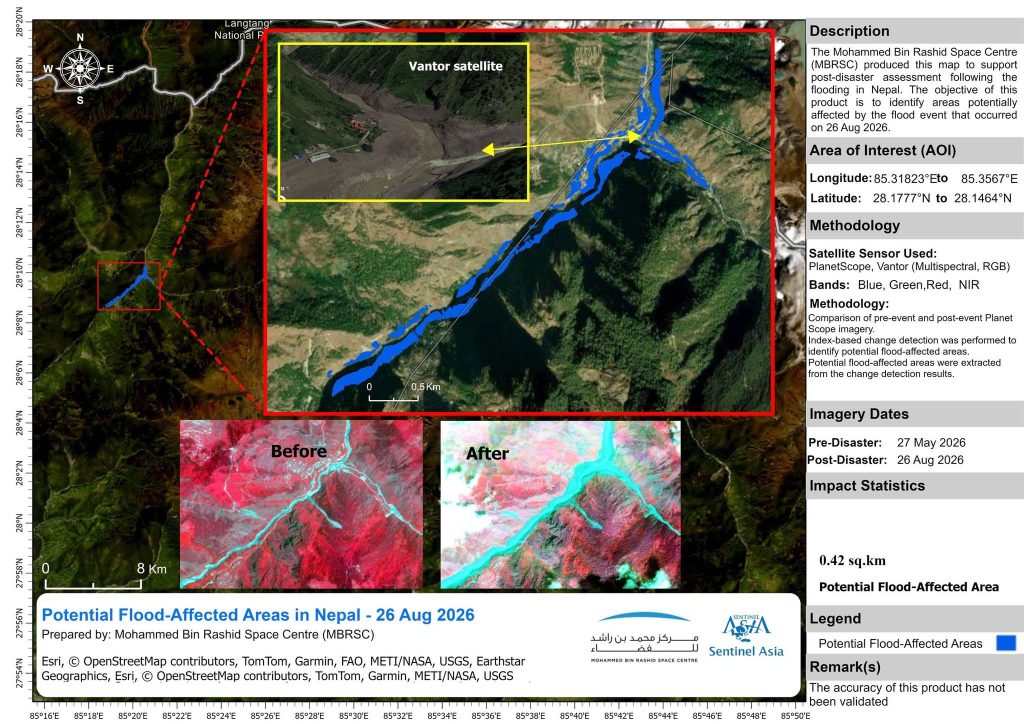
Further assessment by the Mohammed Bin Rashid Space Centre  through Sentinel Asia focuses on specific points of interest. It highlights the vast area affected by comparing pre-and-post-event satellite imagery, quantifying the impact with concrete statistics like a potential 0.42 sq.km affected area near a specific monitoring site.
Finally, a visualization from TASA and Sentinel Asia  uses false-color composites to contrast the ‘normal’ state in mid-August with the flooded area on August 28th. The dense white areas indicate the flood-affected zones and mud deposits covering previously vegetated land, showing a total affected area reaching approximately 10 square kilometers.
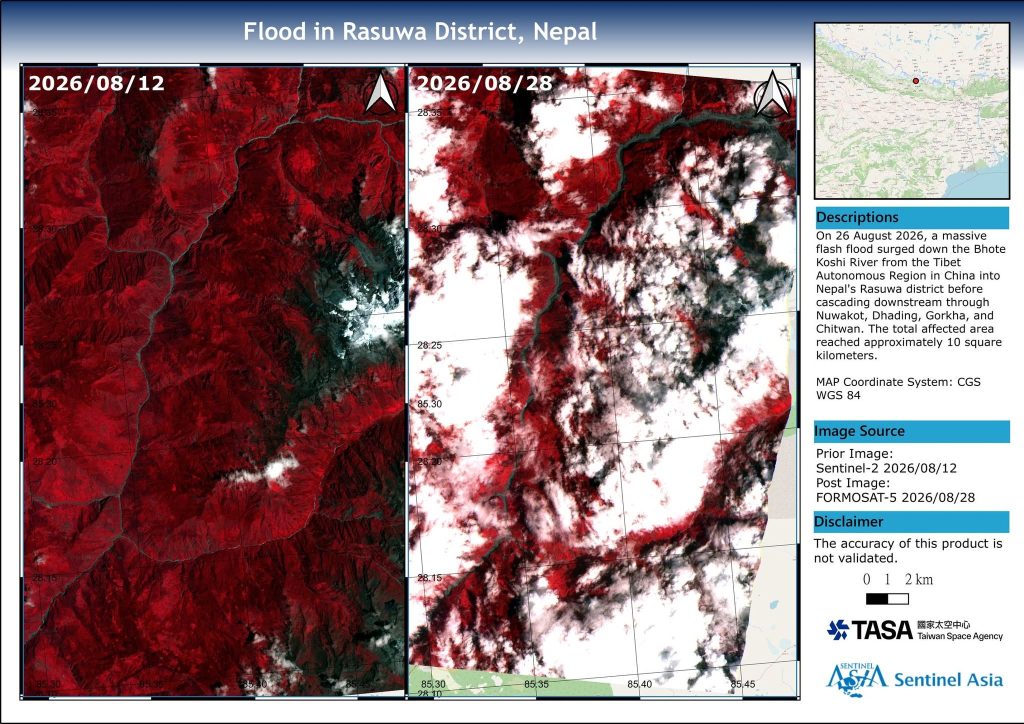
For a deeper understanding and ongoing discussion, these resources from international agencies like Copernicus, TASA, and Sentinel Asia are invaluable.
Inside the Origin of the Rasuwa Mega Flood

On the morning of 26 August 2026, a catastrophic wall of water and debris tore through northern Nepal’s Bhote Koshi corridor, leaving widespread devastation in its wake. While early speculation blamed a ruptured glacial lake, satellite analysis uncovered a far more terrifying origin: an unprecedented mass collapse on the northern flank of the Langtang-Lirung massif. To comprehend why this event wreaked such downstream destruction, one must examine the extraordinary physical scale, volume, and gravitational energy unleashed at the mountain’s source.

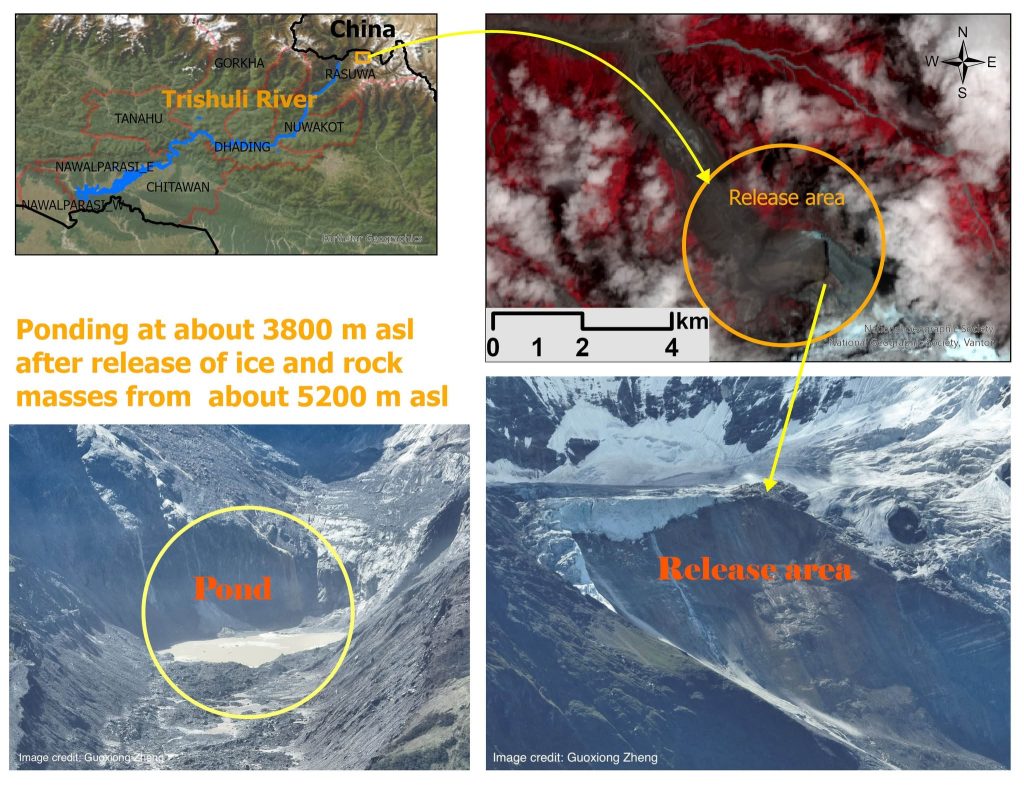
The catastrophe began high up at an elevation of approximately 5,200 meters above sea level. At 8:37 AM, a massive slab of hanging glacier and frozen bedrock violently broke away, plummeting 1,400 meters down to the 3,800-meter mark and slamming into the lower debris-covered glacier. This initial 1,400-meter vertical freefall alone dwarfs Angel Falls, the tallest waterfall on Earth. The colossal impact gouged out a deep depression that instantly formed a new 0.19-square-kilometer lake, simultaneously scouring and mobilizing vast amounts of secondary debris.

The combined torrent then plunged another 1,100 meters into the Lhende River gorge at 2,900 meters. Overall, the mass fell through a total vertical drop of 2,300 meters—nearly three times the entire height of Dubai’s Burj Khalifa and more than double the sheer rock face of Yosemite’s El Capitan.

Source area in Gosaikunda Rural Municipality showing detachment at ~5,200 m and ponding at ~3,800 m (Image Credit: Guoxiong Zheng).

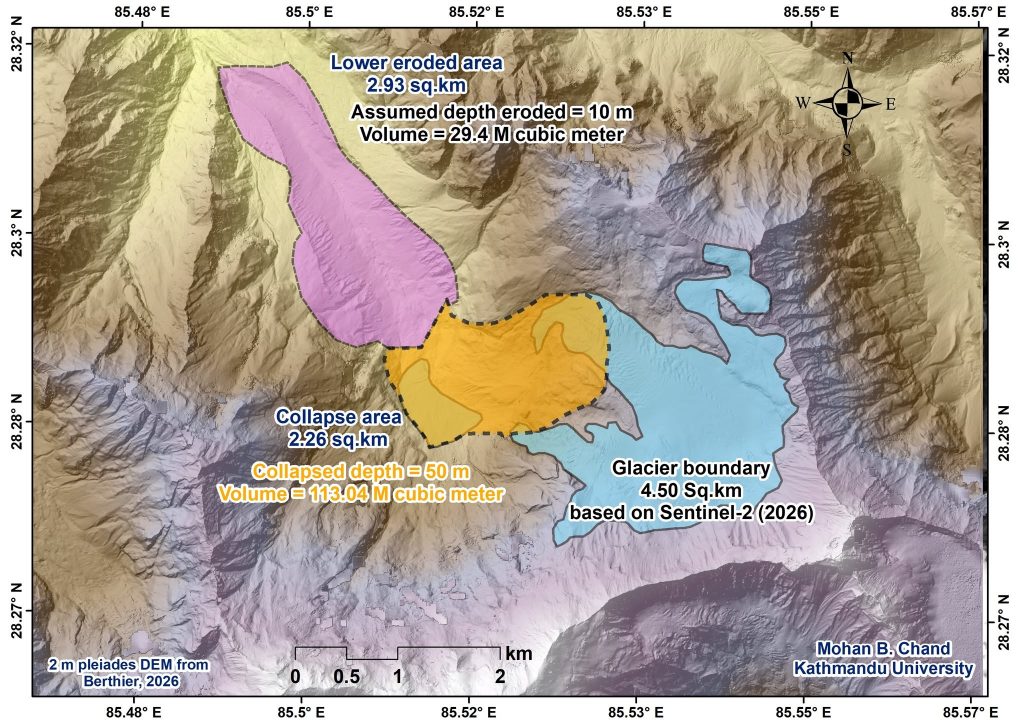
The sheer volume of mobilized earth defies ordinary comprehension. Satellite investigations mapped a 2.26-square-kilometer primary collapse zone averaging 50 meters in depth, alongside a 2.93-square-kilometer secondary erosion track. Together, they ripped away and mobilized over 142 million cubic meters of ice, rock, and sediment. To put that in perspective, this is equivalent to roughly 55 Great Pyramids of Giza or nearly 57,000 Olympic-sized swimming pools of solid mountain material surging down the slopes within minutes. The total disrupted footprint of 5.19 square kilometers is larger than New York City’s Central Park and more than two and a half times the area of the entire nation of Monaco.

Detailed mapping of the 2.26 km² collapse zone and newly created 0.19 km² lake at the impact site

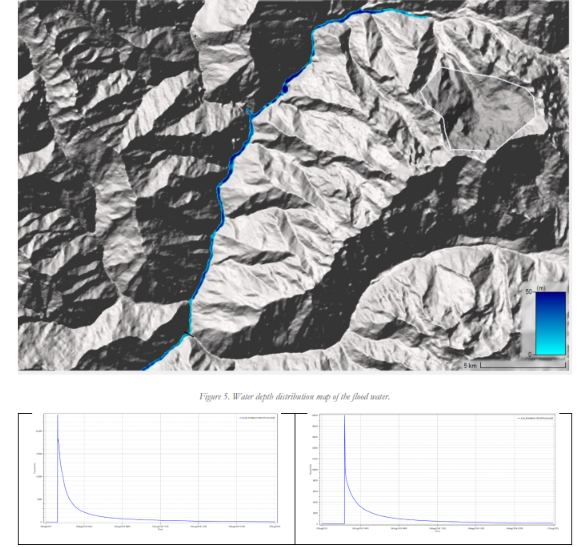
When this immense slurry crashed into the Lhende River, it temporarily choked the narrow gorge before bursting downstream with terrifying kinetic energy. The force of millions of tons slamming against the valley floor was so violent that seismic networks registered ground motion comparable to a local earthquake. Rocketing down the valley at speeds of 54 km/h (15 m/s), the slurry surged past Syaphrubesi with a peak discharge of roughly 23,000 cubic meters per second. That peak flow is nearly ten times the average discharge of Niagara Falls, crammed into a razor-thin Himalayan canyon.

imulated hydrograph illustrating the massive 23,000 m³/s discharge peak recorded along the corridor

Crucially, this mega-flood occurred without any preceding heavy rainfall, highlighting that it was not a conventional weather-driven event. It was instead an explosive chain reaction of high-altitude rock destabilization, permafrost thaw, and glacial entrainment in a geologically fragile landscape. By converting massive gravitational potential energy across thousands of vertical meters into destructive fluid force, the Langtang-Lirung disaster serves as a sobering preview of how cryospheric hazards are evolving in the high Himalayas.

References:

  • Chand, M. B., Kayastha, R. B., Adhikari, S., Pokharel, A., Moktan, B., Bajracharya, H., Basnet, U., & Paudel, P. K. (2026). Rapid situation report: Bhotekoshi-Trishuli catastrophe. Jointly prepared by Youth Alliance for Environment (YAE), Himalayan Cryosphere, Climate and Disaster Research Center (HiCCDRC) – Kathmandu University (KU), and Society for Conservation Biology Nepal.

Space Technology is Nepal’s Next Frontier for Diplomacy

In my latest article for The Diplomat Nepal, I explore why space is no longer a luxury for developing nations ?  In this article I explored about the success of NepaliSat-1 and Munal. Embrace the $1.8 trillion global space market by 2035.

I argued that the reality of the 21st century is  space technology is the backbone of modern disaster resilience, climate monitoring and telecommunications.

Having followed our journey from the initial launch in 2019 to the current manufacturing of the RSMS-sat constellation, I believe our greatest strength lies in our soft power diplomacy.

Read More

Nepal’s Black Panthers

A few months ago, a mesmerizing black leopard at Nepal’s Central Zoo took social media by storm. But behind those viral photos lies a deeper, more urgent story about survival. In the December of 2025, I wrote ‘The Melanistic Mystery of Leopards’ on Diplomat Nepal.

Contrary to popular belief, these aren’t a separate species. They are common leopards with a genetic mutation called melanism. While beautiful, their increasing presence in districts like Ilam and Kavre isn’t just luck—it’s a warning sign. In this article I tried to explain how habitat fragmentation and urbanization are pushing these species out of the forests and into human settlements.

Read More

The ‘Sleeping Giant’ of Nepal

Gobinda Prasad Pokharel

Today, a photograph released by the Rastriya Samachar Samiti (RSS) caught my eye. It was a captivating shot of Kumbhakarna Himal. Struck by its beauty, I found myself digging deeper into the story behind this peak. What I discovered was a fascinating blend of culture, mythology and mountaineering history that I felt compelled to share.

Read More

How Nepal Mastered Tiger Diplomacy

Gobinda Prasad Pokharel

When we think of diplomacy we usually picture suits, handshakes and conference rooms. But in Nepal, diplomacy has stripes.

I recently came across an article on Diplomat Nepal titled ‘The Roar of Nepal’s Tiger Diplomacy’. I couldn’t stop thinking about it. We often hear doom and gloom stories about endangered species, but Nepal is writing a different narrative one where conservation isn’t just about saving animals. It’s about national pride, international relations and economic survival.

Read More

Chasing the Indian Flapshell Turtle

Gobinda Prasad Pokharel

It was a normal afternoon in my village home in Urlabari Municipality, Morang District. While walking along the roadside, I noticed something unusual — a tiny turtle barely 100 grams was struggling to move across the concrete path.

Its shell was soft and flexible and with a closer look, I realized it was the Indian Flapshell Turtle — locally called ‘पुतली कछुवा’ or Butterfly Turtle.

Read More

Nepal’s Wildlife Diplomacy

Nepal is again in the forefront of ‘wildlife diplomacy’—from gifting gharial eggs and rhinos earning international goodwill. For the first time ever, elephants have taken center stage in Nepal. In my recent Op’ed Article for Diplomat Nepal Magazine of 2025, August Issue, I explore how this diplomatic pivot—from rhinos to elephants—signals changing times, deeper conservation ties and a new chapter in Nepal’s global engagement.


Gobinda Prasad Pokharel
August 10, 2025

Nepal’s wildlife diplomacy has taken a new turn with the decision to gift two elephants – Khagendra Prasad and Rudrakali – to Qatar. This will mark the first time Nepal has gifted elephants to another country. In the past, Nepal has gifted rhinos, leopards, red pandas, and other wild species.

Nepal continued its tradition of wildlife diplomacy during K.P. Sharma Oli’s first term as Prime Minister. On July 10, 2016, his cabinet decided to gift rhinos to China, making it the first live animal gift since Nepal became a federal democratic republic. Previously, such gestures were mostly made by the Royal family during the monarchy. The decision followed a meeting in January 2016 between then Forest Minister Agni Sapkota and Zhang Jianlong, Director of China’s National Forestry Administration.

Read More

संरक्षण केवल संख्या मात्रै हैन, सहअस्तित्व पनि हो

कुनै समय थियो जतिबेला बाघ मार्नु भनेको गौरव हुन्थ्यो । सन् १९११ मा बेलायती राजा जर्ज पञ्चमको नेपाल भ्रमणका क्रममा केवल एकै दिनमा ३५ वटा बाघलगायतका वन्यजन्तु मारेको अभिलेख छ । नेपालका राजारजौटाहरूले वन्यजन्तुको शिकारलाई एउटा शान र तागतको रूपमा लिन्थे ।

तराई क्षेत्रमा भएको अधिक वन विनाश र शिकारका कारण कुनै समय नेपालमा बाघको संख्या एक सयभन्दा कममा झरेको विगत छ ।

Read More

Royalty and Hollywood for Nepal’s Tigers

Gobinda Prasad Pokharel

It was the second week of Chaitra, 2072 (March 2016), Prince Harry of the United Kingdom was on a rafting trip along the Khoriya River in Bardiya. Bird expert Hem Sagar Baral, wildlife expert Shanta Raj Gyawali, nature guide Rajan Kshetri and others were accompanying the trip. Baral had brought two expensive binoculars made by Swarovski. Aware of the etiquette and formalities needed when meeting a member of the royal family, including appropriate language and dress, the team was cautious. However, Harry stood out as different from other royal family members.

Read More