

Most recently, the Ministry of Forests and Environment constituted a technical committee comprising representatives from the Ministry of Agriculture and the Ministry of Home Affairs to mitigate agricultural losses driven by monkeys. Prior to this, the National Concern and Coordination Committee—which includes members from the Federal Parliament and National Assembly—produced a comprehensive field study report detailing the state of human-wildlife conflict. The diagnostic conclusions across nearly all these studies are remarkably uniform: prioritizing both short-term and long-term socio-ecological impacts remains paramount.
During a recent House of Representatives session, lawmaker and former minister Mahabir Pun asserted that entirely eliminating monkey-related conflict is an insurmountable challenge. Claiming that historical countermeasures had universally collapsed, he noted that building a rocket is actually scientifically easier than finding a simple technology to chase away a monkey.
While the state has not been entirely devoid of attempts, vital questions persist: How should local municipalities be supported in resolving this crisis? Is the nation genuinely incapable, or are our institutional frameworks uniquely broken? These queries remain unanswered. In the mid-hill regions, the phenomenon of monkeys raiding maize crops is an ancestral grievance, tracing back generations. The fundamental disruption has always existed; the contemporary shift lies simply in the modern intensity and frequency of these occurrences.
Currently, our structural Achilles’ heel in primate management is a total deficit of institutional coordination. Merely capturing a troop of monkeys from one locality and abandoning them in another does not resolve the crisis. A few years ago, monkeys from the Jute Mills area in Biratnagar (the capital of Koshi Province) were rounded up and released into the Kanepokhari forest along the East-West Highway. Today, that exact highway stretch is terrorized by the relocated primate troops.
In attempting to resolve a localized issue, the authorities succeeded only in cultivating a new crisis elsewhere. This Morang exercise demonstrates that haphazard relocation merely shifts the geography of the problem rather than solving it. Relocation demands rigorous preliminary studies regarding carrying capacity, ecological baseline, and timing before execution.
Understanding the Primate Balance in Nepal
Nepal handles three distinct species of monkeys, each carrying a separate ecological status:
- The Rhesus Macaque: Noted as ‘Least Concern’ on the global red list, yet acts as the primary source of agricultural and urban friction.
- The Assamese Macaque: Categorized as ‘Near Threatened’ globally and strictly protected under federal environmental laws.
- The Hanuman Langur: Spans four distinct sub-species, balancing between standard ecosystem populations and local vulnerabilities.

The ubiquitously visible species causing the highest degree of friction is the Rhesus Macaque. Its disruptive footprint spans the country. While agrarian communities endure the severest economic setbacks, they are not the sole victims. Pilgrims and religious sites are equally affected. In the Kathmandu Valley’s historical temples and shrines, primate troops routinely snatch ritual offerings, devotional items, and personal belongings from hundreds of visitors daily.
The Root Causes of Escalation
We cannot address the symptom without diagnosing the trigger. The baseline vectors include:
- Systematic fragmentation and shrinking of native natural wildlife habitats.
- Encroachment of dynamic farming properties direct up to forest lines.
- The steady, unchecked drop in natural apex predators—specifically leopards—which traditionally balanced primate numbers naturally.
- The steady availability of high-calorie human waste and deliberate feeding patterns.
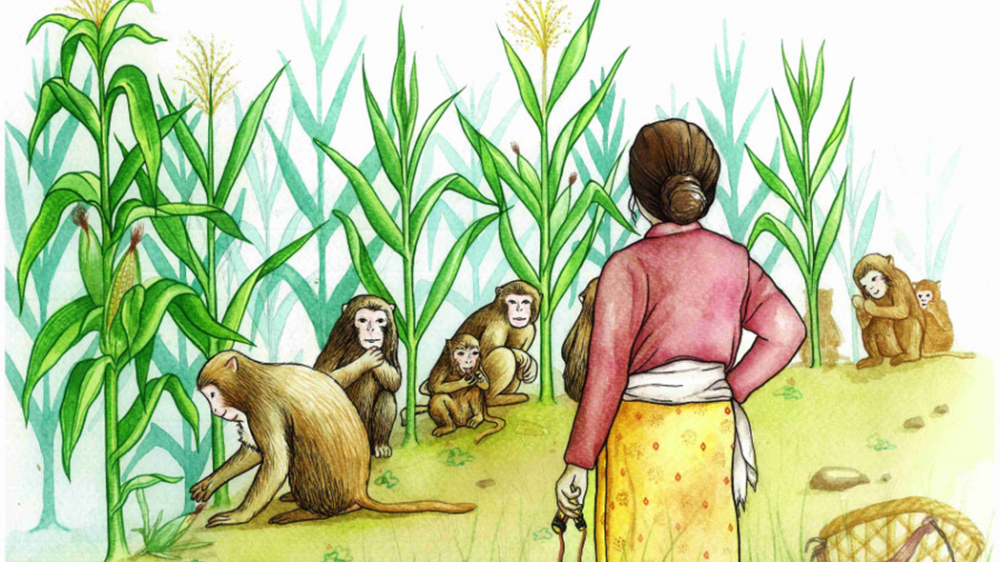
The principal driver drawing monkeys into human settlements is the availability of effortless sustenance. In many regions, this migration is fueled not by an absolute scarcity of forest food, but by the opportunistic preference for calorie-dense, cultivated crops that require minimal foraging energy. In semi-urban zones, the absence of standardized solid waste management provides an ongoing, abundant food source that supports artificial population bubbles.
Shifting to Site-Specific Solutions
The primary reason strategic measures collapse is that we treat all troops identically. Interventions require a clear geographical taxonomy. A dynamic farm raider operates under distinct natural logic compared to a religious site scavenger. Managing them requires three distinct operational avenues:
| Conflict Context | Primary Behavioral Pattern | Strategic Focus |
|---|---|---|
| Agrarian Farms | Driven by seasonal crops, entering field borders out of hunger. | Mid-hill cultivation buffer zones |
| Heritage Shrines | Habituated directly to human religious handouts and daily offerings. | Kathmandu Valley cultural centers |
| Urban Markets | Scavenging effectively on open waste platforms and municipal disposal areas. | Townships and commercial centers |
Tailoring interventions to these specific behavioral profiles yields authentic results. Strategic design can incorporate available acoustic technologies, co-existence frameworks, and structural habitat restoration. Crucially, inter-governmental synchronization across Federal, Provincial, and Local tiers is imperative. With a decentralized structure, clarity must be established regarding specific tasks down to the ward level. Additionally, real-time communication networks to track primate movement and report early crop damage are essential.
Actionable Frameworks: Tactical and Systemic
Sustainable management requires balancing immediate farm defense with clinical long-term stabilization tools.
Short-Term Farm Safeguards: Incorporating botanical defense strategies by cultivating highly non-preferred, pungent boundary crops—such as lemons, limes, turmeric, Sichuan pepper (Timur), or hot chilies. These alter the initial risk-to-reward ratio for scouting troops. Farms can also incorporate solar-powered electrical perimeter boundaries (adapted from elephant control measures) and deploy directional acoustic alerts replicating localized alpha distress warnings to split up moving troops.
Long-Term Population Management: For isolated, high-density environments like urban cultural shrines, strategic biological population limits offer the most humane solution. Targeted laparoscopic sterilization models—which proved effective under parallel ecological strains in Himachal Pradesh, India—work reliably alongside the use of immunocontraceptive options (like PZP).
The Dead Ends: Export Protocols and Culling
Public discourse frequently circles back to international export mechanisms for medical laboratories. In reality, this route is blocked by massive legal, ethical, and international diplomatic challenges. Historically, regional neighbors like India and Bangladesh handled massive primate export contracts. Between 1956 and 1978, India shipped approximately 120,000 rhesus macaques to western clinical centers. However, deep structural pushback on animal welfare rights forced a comprehensive, permanent ban in 1979. Re-activating these transport chains in the modern regulatory landscape remains completely out of reach.
Similarly, the option of state-sanctioned lethal control or “culling” hits a brick wall. A nation like Nepal, deeply anchored in cultural, spiritual, and Vedic structural history, cannot reconcilably evaluate the mass systematic extermination of a species deeply bound to holy and revered spiritual dynamics.
The Horizon of Coexistence
Ultimately, there is no absolute, hands-off scientific cure to erase human-macaque friction entirely. The strategic mindset must transform from ideas of total exclusion toward intelligent, landscape-led coexistence. By securing physical perimeters, standardizing local municipal waste streams, and deploying clean tracking networks directly down to individual village wards, communities can establish strong structural perimeters while successfully preserving the shared natural eco-system.
Translation of my original opinion column published in Kantipur Daily.
Link: https://ekantipur.com/opinion/2026/05/25/how-to-manage-human-ape-conflict-52-18.html