By : Gobinda Prasad Pokharel
Following the resignation of British Prime Minister Keir Starmer, Britain is preparing to choose a new Prime Minister. The seat at 10 Downing Street, the main administrative center of the UK, is getting new leadership. Over the past 15 years, seven people have sat in the Prime Minister’s chair.
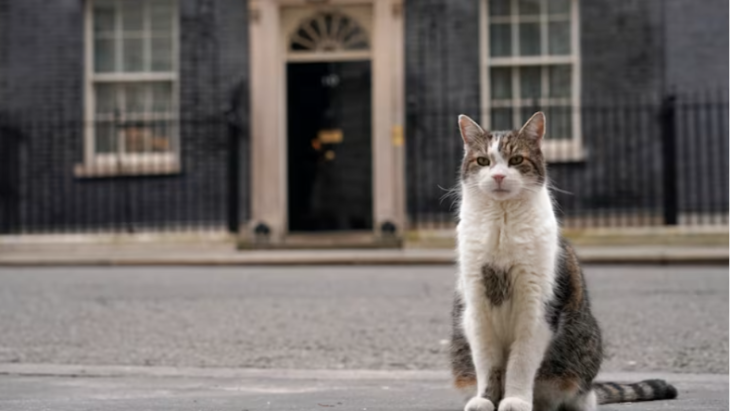
Rather than focusing solely on who the next Prime Minister will be, public discussion has centered heavily on a particular employee of the Prime Minister’s Office—one who sits on the steps in front of the building. This employee is not a human, but a white and brown tabby cat. According to the Prime Minister’s Office, this is ‘Larry the Cat. In the uncertain atmosphere of political transitions in Britain, this cat’s position remains entirely secure.
Larry serves in the role of ‘Chief Mouser’ to the Cabinet Office. No matter who comes to 10 Downing Street as Prime Minister, Larry will remain the chief commander of catching mice.
In the United States, items like the pens used by presidents become historic markers. In Britain, this ordinary domestic tabby cat has become a symbol of the state machinery’s soft power.
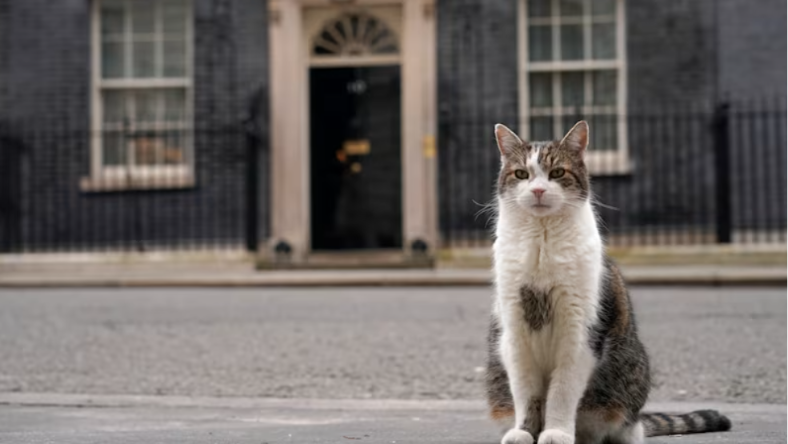
Larry the Cat. Photo Source: Internet
Larry was brought to the Prime Minister’s Office on February 15, 2011. This domestic shorthair cat was only four years old when he arrived at the office from London’s Battersea Dogs & Cats Home.
Over these years, Larry has closely witnessed the tenures of six British Prime Ministers: David Cameron, Theresa May, Boris Johnson, Liz Truss, Rishi Sunak, and Keir Starmer. Now, he is preparing to welcome his seventh Prime Minister.
Larry needs no introduction. His details are prominently and respectfully displayed on the official website of the British Prime Minister, outlining his core duties. His responsibilities include greeting house guests and inspecting security. Larry also tests antique furniture for its napping suitability. The Prime Minister’s Office respectfully features these daily duties on its website.
In his initial days after arriving at the Prime Minister’s Office, he lacked a strong drive to catch mice. There was significant public chatter accusing Larry of being lazy, and the media even dubbed him ‘Lazy Larry’. Over time, however, he proved his capability. Larry began catching mice, securing his reputation.
The Tradition of Keeping Cats in Britain
In British politics and diplomacy, keeping cats is not merely a personal hobby; it is tied to a long history. In British governance, keeping a cat is linked to centuries-old royal heritage. For this, we must look back to around 1514. When Cardinal Thomas Wolsey was appointed ‘Lord Chancellor’ by King Henry VIII, he brought his cats with him. While managing the affairs of Great Britain, Wolsey entered the court of Henry VIII with a large retinue of cats.
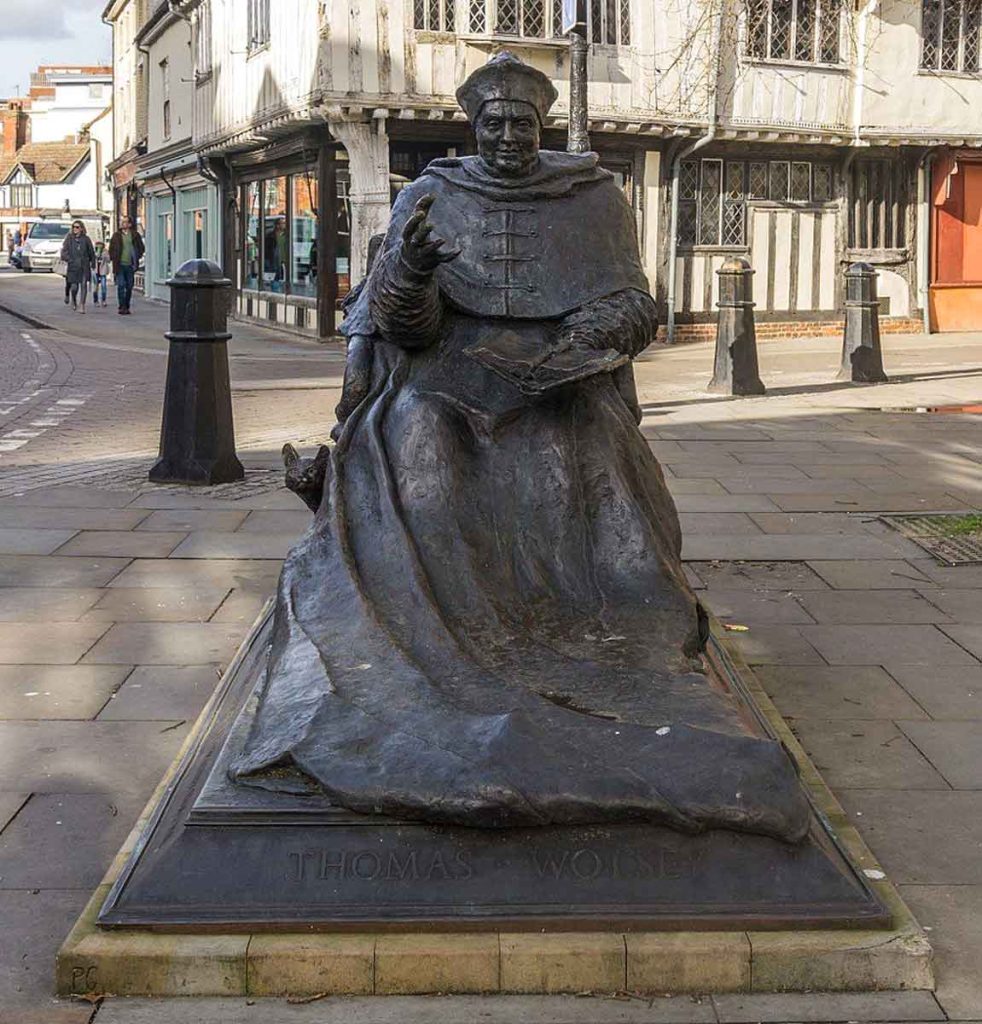
The statue of Cardinal Wolsey in Ipswich, with a cat peeking from behind his robes. Photo: Atlas Obscura.
In the society of that era, public attitudes toward cats were largely negative. Hostile rumors meant cats were frequently viewed as bad omens. Associated with witchcraft and evil spirits, they were often driven from homes—a superstition that persists in various forms today.
However, the reformist Cardinal staged a quiet rebellion against these beliefs. Unmoved by negative public chatter, Wolsey kept his cats by his side during every event. Whether during royal processions or Sunday prayers, he kept his cats close while conducting state affairs, successfully establishing their value. His statue, erected in 2011 at his birthplace in Ipswich, London, honors this connection. The sculpture features a cat peeking out from behind Wolsey’s robes.
The Postal Service Tradition
The written history of officially appointing cats as civil servants with a dedicated government budget dates back to the Industrial Revolution. The documented practice began in May 1869.
At the London Money Order Office of the Royal Post Office, mice were causing severe issues by chewing through important letters and official documents. To solve this, three cats were brought in on a six-month probationary period to hunt the rodents. They were allocated a weekly salary of 1 shilling, which paid for their milk and food.
Following the success of this trial, the cats received a raise in 1873 to 1 shilling and 6 pence per week. Prior to the adoption of the decimal system, the British monetary system relied on pounds, shillings, and pence, where 1 pound equaled 240 pence, and 1 shilling equaled 12 pence.
The policy effectively implemented equal pay for equal work.
According to reports published in various international media outlets, the most famous of these postal cats was ‘Tibs the Great.’ During his 14-year career, he kept the Post Office Headquarters completely rodent-free. He was paid a weekly salary of 2 shillings and 6 pence. When he passed away in 1964, a formal obituary was published to honor him.
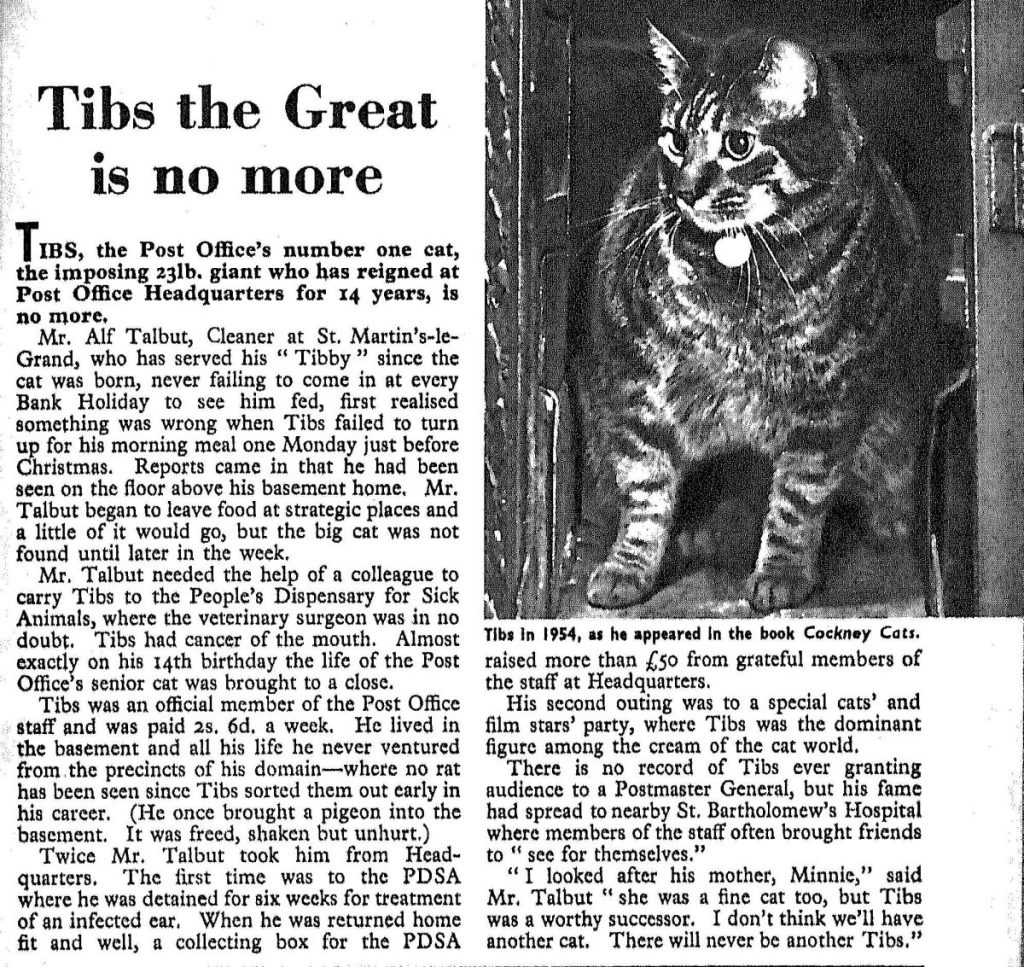
The news of Tibs’ death in the Post Office Magazine, January 1965. Photo: Online.
Following the successful precedent established in 1869, the British government began allocating an official budget for mouse-catching cats at the Prime Minister’s residence (10 Downing Street) in 1929. However, Larry is the first cat to officially hold the formal title of ‘Chief Mouser.’
Similar official assignments exist across other British ministries. The Treasury features a cat named Gladstone as its Chief Mouser, who assumed office in June 2016. His official introduction was slightly delayed due to the ongoing Brexit negotiations at the time. British media noted that within 48 hours of entering the office, Gladstone caught his first mouse, earning widespread praise across the ministry. Today, this cat boasts over 21,000 followers on Instagram. Media reports highlight him not only as an expert hunter but also as an effective public relations asset.
Similarly, the Foreign Office previously appointed Palmerston, a black and white cat, as its Chief Mouser. He was the first cat to officially hold that title in the Foreign Office. His turf wars with Larry at Downing Street generated considerable media coverage—so much so that Palmerston once had to be escorted out under police protection. Britain consistently utilizes these animals as instruments of soft power and diplomatic branding.
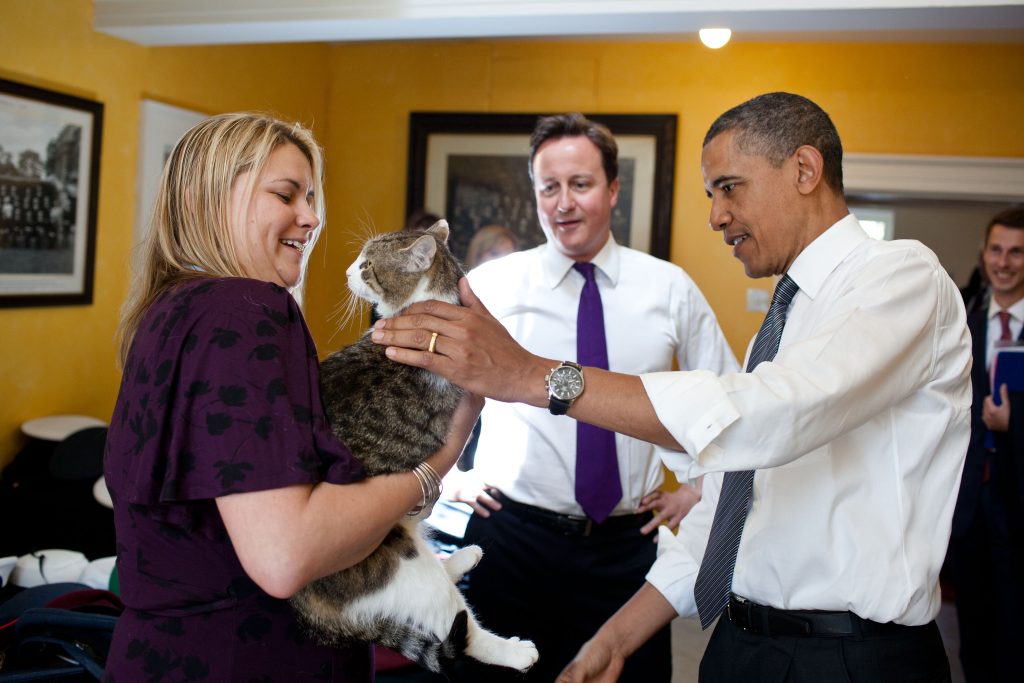
Former US President Barack Obama meeting Chief Mouser Larry at 10 Downing Street in 2011, alongside then-British Prime Minister David Cameron. (Photo: White House)
Whenever images of Larry alongside world leaders like former US Presidents Barack Obama and Donald Trump circulate in international media, they spark broader conversations about British diplomacy.
Interestingly, the expenses for Larry’s upkeep do not come from the state treasury. Instead, his care is entirely funded by voluntary contributions from the staff working at the Prime Minister’s Office.
A Lesson in Institutional Standards
While other nations do not necessarily need to replicate this exact practice, the way Britain treats a domestic animal and highlights it in the public sphere carries massive strategic value. Cultivating similar symbols of soft power within our own domestic institutions could significantly elevate their prestige, character, and public importance.
Preserving fundamental institutional and cultural standards within our political and administrative spheres can yield deeply positive impacts. It introduces an element of “emotional PR” that enriches a nation’s diplomacy and public administration.
In Nepal, the deep reverence shown to animals during various cultural festivals beautifully reflects our state and heritage. Animals such as cows, crows, dogs, oxen, and snakes are revered and worshipped as part of our cultural celebrations. In the diplomatic arena, Nepal has successfully carved out its own unique identity through wildlife diplomacy, presenting one-horned rhinoceroses and elephants as gifts to various nations. Similarly, gifts of Mithila art, intricate wooden sculptures, and symbols of Himalayan identity presented to visiting foreign heads of state serve as our own distinct institutional benchmarks.
The reputation, history, and administrative integrity of any institution must never shift with the changing face of a single ruler or individual. Instead, the system itself must remain resilient. A governance system should be strong enough to transcend the limitations of geography and time. When a state’s institutional frameworks and standards remain firm, their positive impacts endure for generations
My Note: This article was originally published in Nepali Version on Onlinekhabar on 10th Asadh, 2083 BS. Looking past the temporary political cycles of any nation, this piece explores a deeper lesson in governance: how a resilient administrative system maintains its standards, traditions, and institutional prestige regardless of who is in power. Using the unique legacy of Downing Street’s Chief Mouser, it examines the power of systemic stability and what nations like Nepal can learn from emotional public relations and institutional standards.
Article Link: https://www.onlinekhabar.com/2026/06/1961712/larry-the-cat-waiting-for-the-new-prime-minister-in-britain
Archive link: