
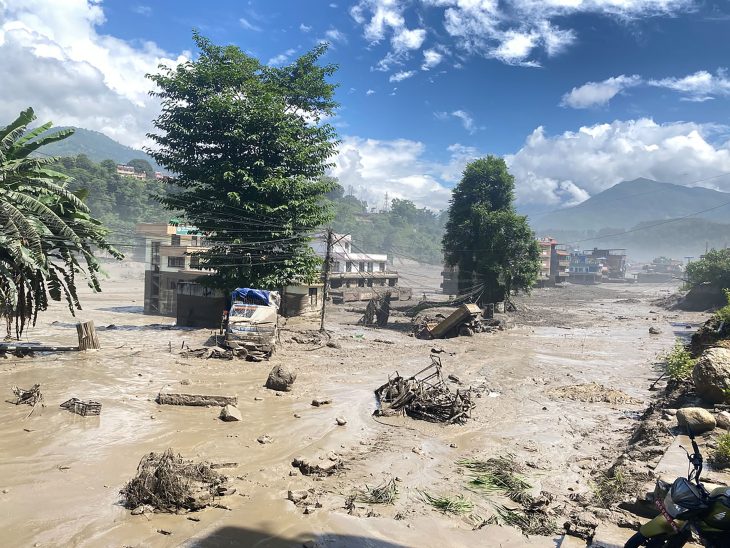
The catastrophic flash flood that recently tore through the Rasuwa corridor along the Bhote Koshi basin has left behind an unimaginable trail of human grief and infrastructural ruin. Critical state infrastructure—including the Miteri Bridge, the Rasuwa customs checkpoint, the NPR 2.8 billion dry port, nearly 440 MW of hydropower facilities, and Nuwakot’s 25 MW solar plant—was either severely damaged or washed away within hours.
While early reports speculated a traditional Glacial Lake Outburst Flood (GLOF), subsequent satellite investigations revealed a far more complex trigger: a massive avalanche and detachment of frozen bedrock and glacier from the northern flank of the Langtang Lirung massif at an elevation near 5,200 meters. Falling into the upper reaches of the Lhende River, this colossal mass of rock, ice, and debris formed a temporary dam that breached catastrophically. The resulting hyper-concentrated debris flow accelerated down the gorge at an estimated 54 km/h, reaching a peak discharge of roughly 23,000 m³/s at Syaphrubesi—engulfing multi-story structures in barely 30 minutes.
“This disaster—nothing short of an inland ‘Himalayan Tsunami’—is a sobering wake-up call. Glaciology is no longer an academic curiosity for lecture halls; it must be treated as an essential defense and national security doctrine.”
1. The Vulnerability of a Fragile Landscape
Nepal sits squarely along the youngest and most tectonically dynamic mountain system in the world. The legacy of the 2015 Gorkha earthquake left steep slopes heavily fractured. At the same time, haphazard infrastructure development, unengineered hillside cuts, and accelerating climate change have compounded this structural vulnerability.
Nepal harbors over 2,000 glacial lakes, with at least 21 identified as critically dangerous. Yet, as the Langtang Lirung event demonstrated, risks are not limited to moraine-dammed lakes. Hanging ice walls, degrading permafrost, rock-ice avalanches, and cascade damming in inaccessible gorges pose an existential threat downstream.
2. The Economic & Strategic Shock
For an economy striving for consistent growth, a single mountain surge can wipe out billions in strategic capital within minutes. Nepal produces less than 0.1% of global greenhouse emissions, yet our communities and clean-energy corridors bear the heaviest burden. Hydropower forms the backbone of Nepal’s domestic energy security and export revenue, but virtually all major powerhouses and transmission lines sit in deep, narrow valleys directly downstream from melting glaciers.
Our national disaster paradigm remains largely reactive: mobilizing state resources for search, rescue, and post-disaster compensation, while chronically underinvesting in early hazard intelligence and preventive design.
3. Modernizing Defense: Integrating Geospatial Intelligence (GEOINT)
Regional defense establishments have already adapted to these realities. India consolidated high-altitude cryosphere surveillance under defense research wings (such as DRDO’s DGRE) to secure border infrastructure. Pakistan’s space agency (SUPARCO) maintains constant orbital monitoring over high-risk Karakoram glaciers.
Nepal must urgently modernize its own operational security. The disaster management wings of the Nepali Army (NA) and the Armed Police Force (APF) need direct access to dedicated Geospatial Intelligence (GEOINT) capabilities.
During the monsoon, optical satellites are blinded by dense cloud cover. However, modern Earth observation technologies—specifically Interferometric Synthetic Aperture Radar (InSAR) and LiDAR—can see through clouds day and night to detect subtle slope creep, expanding glacial dams, and ground subsidence well before an outburst occurs.
The Strategic Roadmap Ahead
- High-Altitude Cryosphere Surveillance Unit: Establish an integrated command center linking glaciologists, geologists, national security apparatus, and GIS specialists to monitor sensitive glacial basins in real time.
- Early Warning Networks: Deploy upstream automated radar water-level gauges and acoustic sensors tied directly to automated sirens and downstream community alerts.
- Climate-Resilient Engineering: Re-evaluate river basin master plans. Mandate that major infrastructure and hydropower installations be designed to withstand high-velocity debris flows, not just legacy rainfall models.
- Update National Security Doctrine: Formally expand Nepal’s defense priorities from traditional borders to include ecological, hydrological, and cryospheric threats.