
Published: July 29, 2026 (Global Tiger Day)
The Milestone We Celebrate
Today, as the global conservation community marks Global Tiger Day 2026, Nepal stands out as a world leader in carnivore recovery. Having successfully achieved the milestone of more than doubling our wild tiger population expanding from 121 in 2010 to 355 in 2022 our landscape strategy enters a new chapter.
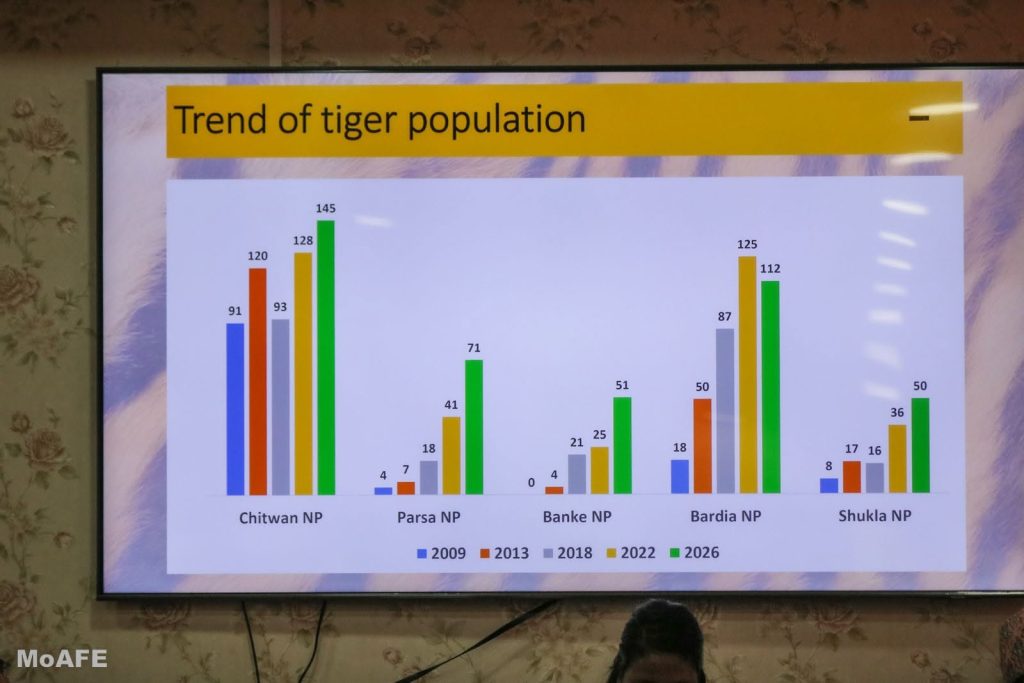
Preliminary Tiger Estimates: 429 Total
Population Estimates Across Protected Complexes
This growth—particularly the surge in satellite complexes like Parsa (71) and Banke (51) reflects years of frontline conservation activities including enforcement, habitat restoration, working with the community and the buffer-zone, and landscape connectivity.
Rethinking the Narrative: Carrying Capacity vs. Spatial Distribution
A prevalent narrative suggests that Nepal’s core national parks have reached their maximum biological carrying capacity, leading directly to human-tiger conflict. However, ecological evidence presents a more reality.
While Bardia records densities exceeding 7 tigers per 100 km² and Chitwan supports over 4 per 100 km², these densities remain below high-density reserves in India (such as Kaziranga or Corbett, which host over 13–14 tigers per 100 km²). Scientific assessments indicate that with continued prey restoration and habitat enhancement, Nepal’s forests can sustainably support over 400 wild tigers.
Field studies show that fewer than 5% of tigers in protected areas are ever involved in conflicts with humans. However, even isolated incidents carry serious social consequences, threatening public support for decades of conservation efforts.
The Shifting Geography: Tigers Head Upland
Climate change and shifting ecological dynamics are altering habitat ranges across Nepal. Recent studies project up to an 80% potential expansion of tiger habitats outside formal protected areas, with animals dispersing along historical corridors into the Chure, Mahabharat, and mid-hill community forests.(Read more in this link )
From documented presences in Dadeldhura and Ilam to recent documentations in Saptari near Koshi Tappu, tigers are actively searching out new territory. Managing these emerging habitats outside core Protected Areas will require institutional strengthening for Divisional Forest Offices and local Community Forest User Groups (CFUGs).
Embracing ‘Tiger Diplomacy’ and Proactive Co-existence
Sustaining Nepal’s wildlife achievements requires shifting focus from pure numbers to coexistence and international partnership [As we mentioned in Oped at Kantipur Daily and Republica Daily ]:
- Leveraging ‘Tiger Diplomacy’ as Soft Power: Nepal’s conservation record provides a diplomatic framework for international collaboration, transboundary landscape preservation, and green funding opportunities.
- Early Warning and Monitoring: Deploying AI-assisted camera traps, satellite telemetry, and rapid-response alerts helps identify dispersing or high risk animals before encounters occur.
- Community Stewardship: Conservation is only sustainable when local communities feel safe and benefit directly. Reducing forest reliance through alternative livelihoods and ensuring prompt relief funding are essential pillars for long-term survival.
The success of wild tiger conservation in the coming decade will be judged not just by population figures, but by how safely people and tigers coexist across shared ecosystems.